
We are committed to doing our part to protect the environment and minimize our carbon footprint.
We recognize that natural resources are limited and seek to protect our environment by implementing sustainability best practices. While our environmental footprint as an insurance and financial services company is relatively modest, we recognize the importance of contributing to a more sustainable future.
Our approach to sustainability
We maintain and communicate policies, programs, procedures and guidelines to guide employees on matters that affect the environment. Our approach to supporting a more sustainable future focuses on measuring performance, reducing waste, and identifying opportunities to operate more efficiently. Key areas of focus include:
- Monitoring waste reduction. We track various waste metrics, such as usage of water, energy, paper, and carbon emissions. The data helps us identify opportunities for improvement and set reduction targets.
- Reviewing legal requirements. We comply with all applicable environmental laws that apply to our facilities and industry. We annually review Horace Mann’s environmental goals and any changes to environmental policy that may affect our operations.
- Looking for energy efficiencies. We conduct ongoing facility evaluations to identify and reduce energy inefficiencies. Horace Mann’s environmentally friendly practices include recycling programs and utilization of Energy Star-certified appliances and LED light fixtures.
Efforts to reduce carbon emissions
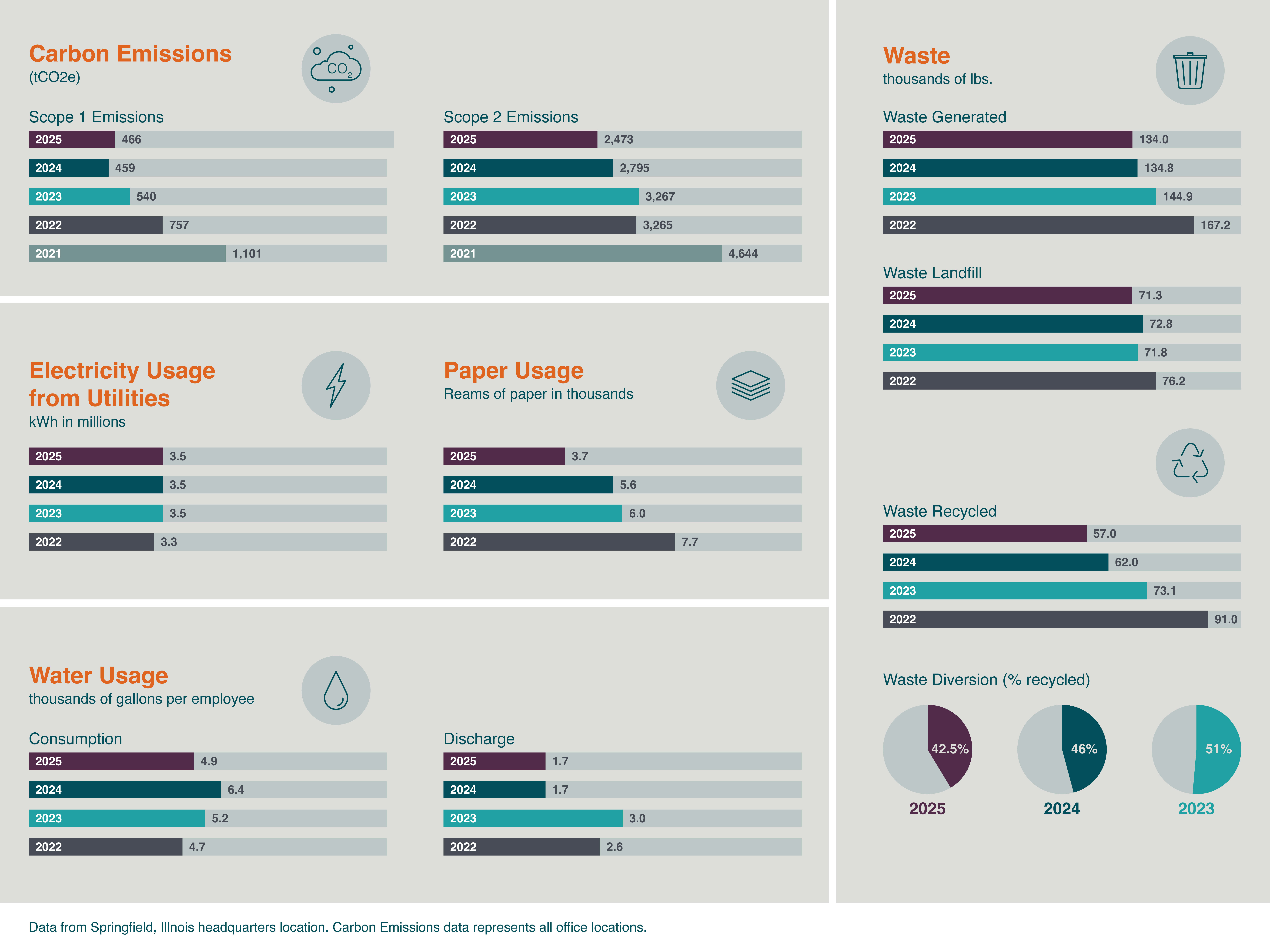
We continue to make meaningful progress toward our long-term emissions goals. In 2023, we updated our Scope 1 and Scope 2 carbon emissions data to include leased properties — as clarified by the Greenhouse Gas Protocol Corporate Accounting and Reporting Standard – and continued our efforts to decrease emissions to achieve our long-term objectives. As a result of our efforts, 2025 emissions are 65% below our base year of 2019, which exceeds our initial reduction timeline ahead of our 2030 goal. Horace Mann aligns our sustainability and financial reporting disclosures with the standards of the Task Force on Climate-Related Financial Disclosures (TCFD) to further communicate our understanding of our climate impacts and management of our climate risks.
In 2023, Horace Mann eliminated steam, which resulted in a 40% reduction in natural gas usage. Horace Mann continued to optimize its real estate footprint, which in turn has lowered operational energy usage and reduced overall scope 1 and 2 emissions.
Our carbon-reduction initiative began in 2019 at our headquarters facility, which included installing a new, more efficient HVAC system; adding LED lighting and lighting motion sensors; and replacing single-pane windows at our 230,000-foot facility with double-pane insulated glass.
In addition, Horace Mann invested in renewable energy by installing more than 500 solar panels at its headquarters location in 2021. Since 2022, renewable solar energy has accounted for nearly 7% of total energy usage.
| 2020 | 2021 | 2022 | 2023 | 2024 | 2025 | |
|---|---|---|---|---|---|---|
| Scope 1 emissions1 | 1,309 tCO2e |
1,101 tCO2e |
757 tCO2e |
520 tCO2e |
459 tCO2e |
466 |
| Scope 2 emissions2 | 4,998 tCO2e |
4,644 tCO2e |
3,265 tCO2e |
3,267 tCO2e |
2,795 tCO2e |
2,473 tCO2e |
Waste reduction measures
We’re also focused on minimizing waste and conserving resources at our Springfield, Ill. headquarters:
- Reduced water usage: Water consumption at our Springfield headquarters location in 2025 was nearly 36% below 2020, although it has risen from an artificially low level during the pandemic as employees return to the office with greater frequency. We continue to focus on conservation initiatives, such as improving ground irrigation, updating plumbing, and promoting conservation practices within our office.
- Lowered waste sent to landfills: Horace Mann recycled more than 42% of its waste. We recycle paper, plastic, metal, cardboard, personal computers, monitors, servers, hard drives, printers and printer cartridges.
- Supporting EVs: We have eight EV charging stations at our Springfield headquarters to recharge employee-owned EVs.
(1) GHG emissions calculations include CO2, CH4, and N2O. Biogenic gases are not applicable to Horace Mann’s GHG inventory. The base year for our calculations is 2019, which was selected because it was prior to the start of the COVID-19 pandemic and the changes in energy use that occurred with it. The GHG Protocol and EPA were utilized to derive emissions factors and global warming potential. We employed the operational control approach when consolidating our emissions and used the GHG Protocol calculation tool when calculating our emissions.
(2) GHG emissions calculations include for CO2, CH4, and N2O. The base year for our calculations is 2019, which was selected because it was prior to the start of the COVID-19 pandemic and the changes in energy use that occurred with it. The GHG Protocol and EPA were utilized to derive emissions factors and global warming potential. We employed the operational control approach when consolidating our emissions.